- What BAC Measures: Blood Alcohol Concentration (BAC) measures grams of alcohol per 100 mL of blood (e.g., 0.08% BAC = 0.80 g/L or 0.80‰).
- Widmark Formula: Combines pure ethanol grams, body mass, biological water distribution (0.68 male average, 0.55 female average), and time.
- Steady Elimination: The human liver metabolizes roughly 0.015 percentage points of BAC per hour (~10–15 grams of ethanol per hour).
- Educational Boundaries: Online estimates show mathematical population averages; they cannot measure active gastric absorption or individual impairment.
What does a blood alcohol percentage calculator actually measure?
Blood alcohol concentration, or BAC, describes the amount of alcohol in a given amount of blood. In the United States it is commonly written as a percentage. A BAC of 0.05% means 0.05 grams of alcohol per 100 milliliters of blood. It is a concentration, not the percentage of your body that is alcohol.
This blood alcohol percentage calculator estimates that concentration from drink volume, alcohol strength, body weight, a body-water assumption and elapsed time. It is an educational model. It cannot sample your blood or breath, measure impairment, or establish when driving is safe. A calculation that looks precise still depends on uncertain information.
How to use this blood alcohol percentage calculator
Start with your body weight and select kilograms or pounds. Choose a body-water factor after reading the explanation beside the field. Add each type of drink and enter the actual serving size, alcohol by volume (ABV) and quantity. Preset drinks are starting examples; change them to match the label and the amount actually consumed.
Enter the number of hours since the first drink in the recorded session. This simplified model does not track a separate absorption curve for each serving. If you have just consumed more alcohol, BAC may continue rising even when the calculator subtracts elapsed time. Submit the form to see the estimate, total ethanol and a range showing the effect of changing the assumed elimination rate.
This BAC estimator accepts beer, wine, spirits or a custom serving. Different serving types can appear in the same calculation. Changing an input clears the previous result so an old number is not mistaken for a new calculation. If a drink's strength is unknown, do not treat a guessed value as dependable.
The method behind the number
The calculator first converts each drink to grams of ethanol: volume in milliliters × ABV as a decimal × 0.789 × quantity. It adds those grams and divides by body mass and a selected distribution factor. It then subtracts a simplified hourly elimination amount and prevents the result from falling below zero.
Like every blood alcohol percentage calculator built on this equation, the factors 0.55 and 0.68 are broad modeling assumptions, not individual measurements or guaranteed values for a sex or gender. The displayed sensitivity range changes the elimination assumption from 0.010 to 0.020 percentage points per hour. It does not include all sources of uncertainty and is not a statistical confidence interval. Read the full Widmark formula and BAC estimation guide for a worked example.
One glass is not always one standard drink
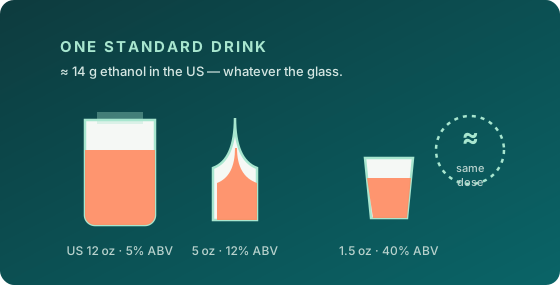
A US standard drink contains about 14 grams of pure alcohol according to NIAAA. A 355 ml beer at 5% ABV contains about 14.0 g, but a 500 ml beer at 8% contains about 31.6 g. Both may be called “one beer,” although their ethanol amounts differ substantially.
Standard-drink definitions also change across countries. Australia uses 10 g, a Canadian standard drink contains approximately 13.45 g, and a UK unit is defined as 10 ml of pure alcohol, often rounded to 8 g. Those are accounting conventions, not driving allowances. The ABV and standard-drink calculator compares the same beverage across these definitions — the same arithmetic this blood alcohol percentage calculator uses on every row.
How to interpret your estimated blood alcohol percentage
Read the estimate together with its assumptions. A higher modeled value generally reflects more reported alcohol relative to the selected body-water amount. A lower result can come from less ethanol, a larger body mass or a longer elapsed time. None of these relationships guarantees a specific individual's actual concentration — which is why a blood alcohol percentage calculator shows a modeled range, not a measurement.
The BAC chart provides blood-unit conversions and describes why typical effects are not diagnostic categories. Do not assume that a value below a familiar legal threshold means unimpaired. The legal-limit reference explains jurisdiction differences and why no calculator should translate a threshold into permission to drink and drive.
A displayed 0.000% only means the BAC estimator reached its mathematical floor. It does not confirm a zero laboratory measurement. Fatigue, hangover symptoms, medication and other substances may still affect functioning independently of the calculated BAC.
What changes BAC besides drink count
Two people drinking the same beverage can reach different concentrations, and the reasons are practical rather than mysterious. Body mass and body-water share matter because alcohol distributes in body water; a smaller person generally reaches a higher concentration from the same dose. Biological sex and related physiology influence body-water share, which is why the model exposes a factor choice instead of hiding it. Food in the stomach slows how fast alcohol reaches the bloodstream, shifting the timing of the peak rather than the total amount processed.
Speed of drinking matters too: the liver clears alcohol at a fairly steady rate, so spacing servings out keeps the concentration lower than drinking them back-to-back. Strength and serving size complete the picture — a generous home pour of wine can contain double the ethanol of a measured restaurant pour, and a craft beer at 8% ABV carries more alcohol than a light beer at 4%. Carbonation and mixer choice can modestly affect absorption speed. None of these factors is reliably knowable after the fact, which is part of why estimates stay estimates.
A worked example of the estimate
Consider a 75 kg person using the 0.68 factor who has had two 355 ml beers at 5% ABV over two hours. Each beer contains about 355 × 0.05 × 0.789 ≈ 14.0 g of ethanol, so two beers supply about 28 g. The formula gives roughly 28 ÷ (75 × 0.68 × 10) ≈ 0.055%, then subtracts about 2 × 0.015 for two elapsed hours, landing near 0.025%.
Change one input and the answer moves immediately. The same two beers at zero elapsed time model to roughly 0.055%. A 55 kg person using the 0.55 factor with the same drinks and timing models to roughly 0.093% — above the US per-se limit on paper despite being the same drink count. The lesson is exactly the one the whole site repeats: the drink count is not the variable that decides the number, and the number itself is still an estimate. No blood alcohol percentage calculator can change that — the inputs decide.
Why time matters more than people expect
Alcohol elimination is roughly linear at a fixed rate for a given person: an often-quoted average is around 0.015 percentage points per hour, with meaningful variation between people and occasions. The practical consequence is that leaving a large gap between the last drink and driving does more to lower BAC than almost anything else a person can choose — but the effect takes hours, not minutes, and it cannot be accelerated. No blood alcohol percentage calculator can hurry a liver.
The timing people usually misjudge is the rise, not the fall. Peak concentration typically arrives well after the last sip while absorption continues, and carbonated drinks or an empty stomach can shift that peak earlier and higher. The absorption timing guide covers this in detail. For clearance, read the sobering-up guide, and never convert either into a driving schedule.
What can make an estimate inaccurate?
Common problems include underestimated pours, stronger-than-expected drinks, forgotten servings and an incorrect time entry. The model also cannot account fully for food, absorption timing, individual physiology or differences in elimination. It assumes that the reported drinks can be represented with a simplified formula.
This means a “most accurate BAC calculator” claim would be misleading — a blood alcohol percentage calculator is only as good as its inputs and assumptions. More decimal places do not turn assumptions into a measurement. If you need a clinical or legal measurement, follow the appropriate professional testing procedure. Never use an online number to dismiss serious symptoms or decide whether to drive.
For related questions, explore alcohol absorption, sobering up and the distinction between alcohol clearance and laboratory detection. Each addresses a different part of the process.
Private by design, straightforward by choice
The calculator runs in your browser. The site does not send the weight, drink or time fields to a calculation server and does not save them in local storage. Reloading the page resets the form. Ordinary website hosting may still generate access logs, as explained in the privacy policy.
There is no account requirement, advertising script or analytics integration in this edition. The method and source links are available to read without using the form. If you spot an error, email info@bac-calculator-us.com with the page address and a description; avoid including sensitive personal or medical details.
About the researcher behind this tool
Alex Morgan develops educational tools focused on alcohol pharmacokinetics, blood alcohol concentration (BAC), and real-world drinking safety. BAC/clarity was created out of a simple observation: most people don't think in grams of pure ethanol or enzymatic liver clearance—they think in pints, rounds, and hours. That disconnect often leads to dangerous misjudgments about impairment.
Every calculation model on this site keeps its mathematical assumptions visible and cross-referenced with public-health literature from the NIAAA, CDC, and NHS. Read Alex's full background, research approach, and editorial standards on our About page.