- Alcohol Mass Formula: Grams of pure ethanol = Volume (ml) × (ABV% ÷ 100) × 0.789 (ethanol density at 20°C).
- Four National Standards: US Drink = 14 g; UK Unit = 10 ml (~7.89 g); Australian Drink = 10 g; Canadian Drink = 13.45 g.
- Mixer Fallacy: Adding juice, tonic, or ice increases liquid volume and dilutes flavor, but the total grams of ethanol remain identical.
- Multi-Shot Drinks: Cocktails with multiple liquors (margaritas, martinis, long islands) frequently deliver 28–35+ grams of alcohol (2 to 2.5 standard drinks).
What does alc/vol mean?
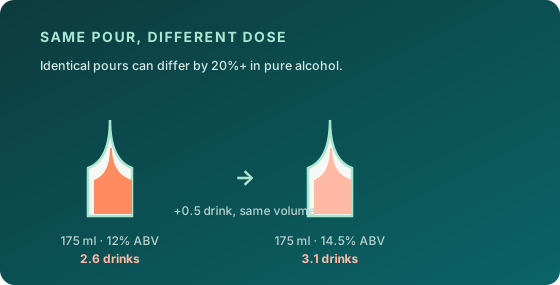
Alc/vol is another way of writing alcohol by volume, usually abbreviated ABV. A beverage labeled 5% ABV contains approximately 5 ml of pure alcohol in every 100 ml of beverage. The percentage describes the liquid in the container, not the blood alcohol level of the person drinking it.
An alc vol calculator combines that percentage with the amount poured. Without serving size, a strength percentage cannot tell you the total ethanol amount. A small high-strength serving and a large lower-strength serving can contain similar grams of alcohol. That is why both fields matter.
How to calculate alcohol content
Choose a drink preset or add a custom entry. Enter the actual volume, choose milliliters or US fluid ounces, and copy the ABV from the label. Set quantity to the number of identical servings. For drinks with different volumes or strengths, add separate rows rather than averaging them casually.
The tool adds the ethanol in all rows and shows the total in grams. It also divides the total using different countries' standard-drink definitions. Those conversions help compare amounts; they do not assess intoxication, personal risk or whether a person has stayed within a legal driving limit.
When a cocktail's recipe is known, enter each alcoholic ingredient separately. Add nonalcoholic mixers only if needed for your own volume records; zero-ABV liquid contributes no ethanol. If the pour or recipe is unknown, the calculator cannot recover that missing information from a drink's name.
The alcohol-volume formula
The factor 0.789 is an approximate density for ethanol in grams per milliliter. Multiplying volume by the ABV fraction gives milliliters of pure alcohol; multiplying by density gives grams. The density assumption is suitable for educational estimates, not a laboratory assay.
For a 330 ml drink at 5% ABV, the pure alcohol volume is 16.5 ml and the mass is about 13.0 g. For a 150 ml glass at 12% ABV, the corresponding amount is 18 ml or about 14.2 g. Rounding the result should not be mistaken for exact measurement of a real pour.
Standard drinks are not internationally identical
| Convention | Definition used | Calculation |
|---|---|---|
| United States | 14 g ethanol | grams ÷ 14 |
| Australia | 10 g ethanol | grams ÷ 10 |
| Canada | 13.45 g ethanol | grams ÷ 13.45 |
| United Kingdom | 10 ml ethanol per unit | volume × ABV ÷ 1,000 |
The UK unit is often described as 8 g of alcohol, but that is rounded. This tool uses the 10 ml definition directly for UK units, so it follows the familiar NHS formula. A UK unit and a US standard drink are not interchangeable.
Country-specific health guidance may use these definitions differently. The table is a conversion reference, not a recommendation to consume the displayed amount. Consult the appropriate local public-health guidance for health advice.
Why a larger or stronger serving changes the total
A 500 ml beer at 5% ABV contains roughly 19.7 g of alcohol. Raising its strength to 8% without changing volume raises the amount to about 31.6 g. The beverage may still occupy one glass, but its alcohol content has increased substantially.
A 750 ml bottle of wine at 13% ABV contains about 76.9 g. Dividing the bottle into different numbers of glasses changes the amount per glass, not the bottle total. An informal “glass of wine” count loses this information unless the pour size is known.
For spirits, a 45 ml measure at 40% ABV contains approximately 14.2 g. Adding a mixer increases the finished volume but does not remove the ethanol in that measure. Ice melting has the same distinction: concentration in the glass can change while the original alcohol amount remains.
This is not a brewing ABV measurement
This calculator needs a known ABV. It does not infer alcohol strength from fermentation readings, original gravity or final gravity. Brewers need a method appropriate to their measurements and process. Nor does mixing two liquids necessarily produce perfectly additive physical volumes for precision laboratory purposes.
If a drink has no trustworthy strength label or recipe, use caution about any estimate. Homemade or unlabelled beverages can have uncertain composition. Do not invent a percentage simply to obtain a precise-looking standard-drink total.
Alcohol grams versus blood alcohol concentration
Alcohol content is a property of the drink. BAC depends on the alcohol consumed and what happens in a person's body over time. Two people consuming the same grams can have different concentrations, and a single person can respond differently across circumstances.
The blood alcohol percentage calculator adds body-weight, distribution and time assumptions to illustrate that distinction. The formula guide explains the uncertainty. Neither a gram total nor a modeled BAC establishes a safe number of drinks or a time to drive.
For transport after drinking, choose an option that does not rely on a calculation. For a health concern or an unexpected reaction, seek qualified advice. If someone is difficult to wake or breathing abnormally, contact local emergency services rather than entering drinks into a calculator.