- Breathalyzer Detection Window: Alcohol remains detectable on alveolar breath for 12 to 24 hours depending on peak BAC and total quantity consumed.
- Blood-to-Breath Partition: Evidential breath testing relies on a statutory 2,100:1 partition ratio between blood alcohol and deep lung (alveolar) air.
- Mouth Alcohol Interference: Burping, acid reflux, or recent mouthwash can create false high spikes—officers require a mandatory 15–20 minute pre-test observation period.
- No Masking Agents: Mints, gum, and peanut butter only mask odor; they do not alter the ethanol vapor diffusing from pulmonary blood into breath.
Alcohol smell is not a BAC measurement
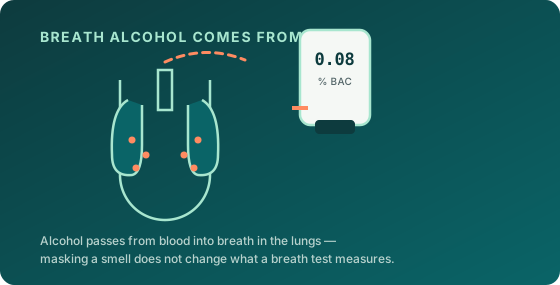
The smell someone notices after drinking is not a calibrated reading. Beverage ingredients, material in the mouth and ordinary oral conditions can affect odor. The absence of a smell does not prove that alcohol is absent from the bloodstream.
This distinction answers much of the question “how long does alcohol stay on your breath?” If you mean odor, there is no dependable universal duration. If you mean a breath alcohol test, the result depends on actual alcohol concentration, the device and the testing procedure. Neither question can be answered reliably from how fresh someone's breath seems.
What breath alcohol testing measures
As blood passes through the lungs, alcohol can exchange with the air that is exhaled. Breath alcohol instruments use a breath sample to assess alcohol concentration. Properly performed testing is different from an online BAC estimate, which calculates from self-reported information.
Different places express breath results using different units, and a legal breath threshold is not necessarily written with the same number as a blood threshold. Always read the unit and official local guidance. The legal-limit guide explains why blood and breath figures must not be casually interchanged.
Why there is no fixed breath-detection window
The amount consumed and the person's alcohol-processing time influence how long alcohol remains measurable. A larger ethanol dose, an extended session and continuing absorption can change the timeline. Device sensitivity and the purpose of testing also matter.
A statement such as “it disappears after a set number of hours” leaves out too many variables. It may describe a rough observation without applying to the person being tested. Avoid using internet detection-window tables to schedule a test or decide whether to drive. Only an appropriate measurement addresses concentration at the time of sampling, and a measurement does not assess every form of impairment.
Mouth alcohol and sampling procedures
Alcohol remaining in the mouth can affect some readings shortly after consumption. That is one reason formal procedures may include an observation period and rules about recent food, drink or other substances. Follow the instructions of the trained operator or the device manufacturer rather than improvising a procedure.
This is a testing-quality issue, not a way to make bloodstream alcohol disappear. Do not attempt to manipulate the sample or use a website to second-guess a formal test. If a result is being used in a clinical, workplace or legal setting, questions about the procedure belong with the relevant professional.
Why freshening your breath does not sober you up
Brushing teeth, chewing gum or drinking coffee may change odor or alertness. They do not establish that ethanol has been removed from the blood. Some mouthwashes also contain alcohol, making assumptions based on mouth freshness especially unhelpful.
Water, food and strong flavors should not be treated as methods for changing an alcohol test. This site does not provide test-evasion instructions. For understanding the underlying process, read how sobering up works; for comparing the actual alcohol in beverages, use the alcohol-volume calculator.
Consumer devices and their limitations
A personal breath-testing device may provide more direct information than a drink-count formula, but its quality, calibration, sampling method and correct use affect the reading. An inexpensive or poorly maintained device should not be treated as a definitive legal or medical instrument.
Even a low reading does not evaluate fatigue, other drugs, illness or reaction time. Do not use the result as permission to drive. If you require a measurement for a medical or legal reason, use the appropriate professional testing pathway and follow its instructions. An online estimate cannot certify or dispute that result.
How evidential breath instruments work
Law-enforcement and workplace instruments are typically built around either fuel-cell sensors or infrared spectroscopy. A fuel cell reacts with alcohol in the breath sample and produces an electrical signal proportional to its concentration. Infrared instruments identify ethanol molecules by how they absorb specific wavelengths of light. Both approaches still depend on delivering a valid, deep-lung breath sample rather than air from the mouth.
Because these devices are physical instruments, they drift over time. Formal programs therefore require scheduled calibration against known alcohol standards, and evidential results usually need supporting procedures: an observation period before sampling, duplicate readings that agree within a tolerance, and automatic checks for interfering substances. A consumer keychain device rarely implements any of this, which is a large part of the quality gap.
Breath-to-blood: a relationship, not a swap
Breath instruments display a breath-alcohol concentration and rely on a fixed conversion relationship to report an equivalent blood figure. The commonly used partition relationship is roughly 2,100 to 2,300 liters of breath containing the same alcohol as one liter of blood, and a simplified ratio is built into how many devices display their result.
That ratio is an average. A specific person, at a specific moment, can sit somewhat above or below it, which is one reason breath and blood results for the same event are not expected to match exactly. In the US, a breath result of 0.08 grams per 210 liters and a blood result of 0.08% are treated as equivalent thresholds in most statutes, but the exact statutory wording varies. This is why comparing a bare number across sample types, jurisdictions or devices invites error.
What actually drives the measurable timeline
Three variables do most of the work in how long breath remains positive after drinking. First, total ethanol dose: a session of several large servings takes longer to clear than a single small one. Second, absorption state: while alcohol is still entering the bloodstream, breath readings can continue rising even though drinking has stopped. Third, individual elimination: the rate at which a particular person clears alcohol varies and is not something a formula can measure in advance.
Device sensitivity and the testing threshold complete the picture. A laboratory method can detect smaller concentrations than a roadside screening device, so the same person could produce a negative screening result and a positive laboratory result from samples taken at nearly the same time. None of these variables turn a rough time estimate into a planning tool.
Choose the right question
If the concern is transport after drinking, arrange a non-driving option. If it is ongoing alcohol odor without recent drinking or another unexplained symptom, ask a healthcare professional rather than assuming the cause. If it is a formal test, ask what substance, sample and method are being assessed.
Blood alcohol, breath alcohol and urine alcohol biomarkers answer different questions. A urine biomarker can reflect prior exposure without showing current impairment. Our alcohol-in-your-system guide compares these concepts and links to more detailed explanations.