- Detection Windows: Pure ethanol remains detectable in urine for 12–24 hours; EtG (ethyl glucuronide) and EtS metabolites remain detectable for 48 to 80 hours after heavy drinking.
- Screening vs Confirmatory: Point-of-care rapid test strips screen for recent ethanol exposure, whereas forensic lab tests (LC-MS/MS) isolate specific breakdown metabolites.
- Fixed Metabolic Rate: Liver enzymes clear alcohol at a steady ~0.015% per hour. Water, cranberry juice, or exercise cannot accelerate liver metabolism.
- Calculator Limits: A 0.00% blood alcohol estimate does not guarantee a negative urine test, as biomarker excretion lags blood clearance by days.
Start with the name of the test
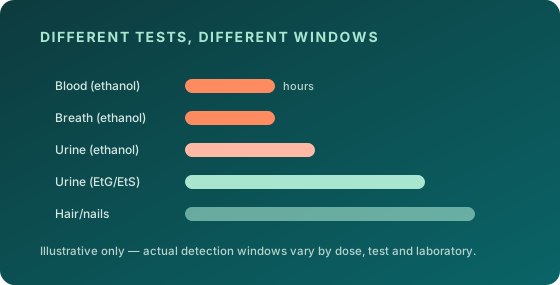
When someone asks how long alcohol stays in urine, the first useful question is what the laboratory is measuring. “Urine alcohol test” is an umbrella description. It may mean a direct ethanol test, an ethyl glucuronide test, an ethyl sulfate test, or a panel combining markers. Those tests answer different questions and cannot share one reliable countdown.
Look at the request form or report for the analyte name, specimen type, reporting units, and cutoff. If the paperwork is unclear, ask the ordering clinician or testing provider. Knowing the actual test is more useful than relying on a headline that promises alcohol disappears after a fixed number of hours.
Ethanol, EtG, and EtS are different measurements
| Test | Measures | Main interpretation issue |
|---|---|---|
| Urine ethanol | Alcohol itself | Recent presence does not directly equal current blood concentration |
| Urine EtG | Ethyl glucuronide, an alcohol metabolite | Can outlast ethanol; cutoff and context affect interpretation |
| Urine EtS | Ethyl sulfate, another alcohol metabolite | Often interpreted with EtG and the clinical history |
ARUP Consult's laboratory guidance distinguishes the shorter ethanol detection period from EtG/EtS detection that may extend for days. These are general descriptions, not a guarantee for a particular sample. A metabolite result should not be treated as evidence that someone is currently intoxicated.
Why an “80-hour test” is not a personal deadline
A detection window describes observations under particular conditions. It does not tell every individual the exact moment their result will change. A phrase such as “up to several days” can describe some testing situations without meaning every drink remains detectable for that long, or that all samples become negative at that boundary.
Published windows also depend on the study population and laboratory method. A study of a small amount of alcohol and one cutoff cannot automatically explain a different amount and a different cutoff. Treat simplified labels as background information. If a result has medical, employment, or legal consequences, the laboratory's actual method and the relevant program's interpretation are what matter.
Factors that can change urine test interpretation
- Amount and pattern: a single event and repeated drinking are not interchangeable histories.
- Time of collection: the report concerns a particular sample collected at a particular time.
- Analytical cutoff: laboratories decide how a measured concentration is categorized under their method.
- Specimen quality: collection, handling, and validity checks affect what can be concluded.
- Clinical context: health history and the reason for testing help the clinician interpret the result.
This list is not a formula for predicting a result. It explains why two apparently similar situations can lead to different reports. The SAMHSA biomarker advisory discusses the need for context, including possible non-beverage alcohol exposure, when interpreting EtG findings.
What a cutoff means in plain language
A laboratory cutoff is a decision threshold applied to a measured result. “Negative” generally means the finding does not meet the method's positive reporting criterion; it does not necessarily mean that no trace exists. “Positive” identifies a finding that needs interpretation within the test's purpose and procedures.
For example, imagine two methods that report the same measured concentration but use different decision thresholds. Their positive-or-negative labels might differ without either instrument contradicting the other. This is a general testing principle, not guidance for choosing a threshold. Ask the provider to explain the units and cutoff on your own report, especially if you are comparing reports from different laboratories.
Why a BAC calculator cannot predict a urine test
A BAC calculator estimates a blood concentration from drink information and assumptions. It does not measure urine and does not model every metabolite used in laboratory testing. A displayed zero therefore cannot establish that urine EtG or EtS will be negative.
The reverse distinction matters too: a positive metabolite result is not a numerical blood alcohol reading. Do not convert an EtG concentration into a drink count or use it to reconstruct a precise BAC without qualified interpretation. If you want to understand the relationship between sample types, our guide to alcohol in your system separates current alcohol, later biomarkers, and lingering symptoms.
How to approach an upcoming test
Follow the instructions supplied by the testing provider and give an accurate account when asked about drinking, medication, or relevant exposure. Do not change medication or attempt to manipulate a sample because of an online claim. If a preparation instruction conflicts with medical advice you have received, resolve that with the clinician or provider.
Useful questions include: What substance is being measured? Is this an initial screen or a confirmed laboratory result? What will a positive finding mean in this program? Who can explain or review an unexpected result? Asking these questions before collection can prevent confusion later without assuming an outcome or trying to manufacture one.
What to do with an unexpected result
Keep a copy of the report and note the collection time, the test name, and the information you supplied. Contact the ordering clinician or designated reviewer through the program's official process. Explain relevant facts clearly rather than trying to interpret an isolated number from a search result.
An online article cannot determine whether a particular result proves beverage alcohol use, a specific amount, or a violation of a rule. Those conclusions may require confirmatory testing, specimen information, and the applicable policy. If testing is part of treatment, discuss the result openly with your care team; a constructive conversation about support is more useful than a predicted passing time.